George Crumb's Personal Crystallization of American Postmodern Trends By Kyle Gann
Delivered June 10, 2017, at the Holland Festival in Amsterdam
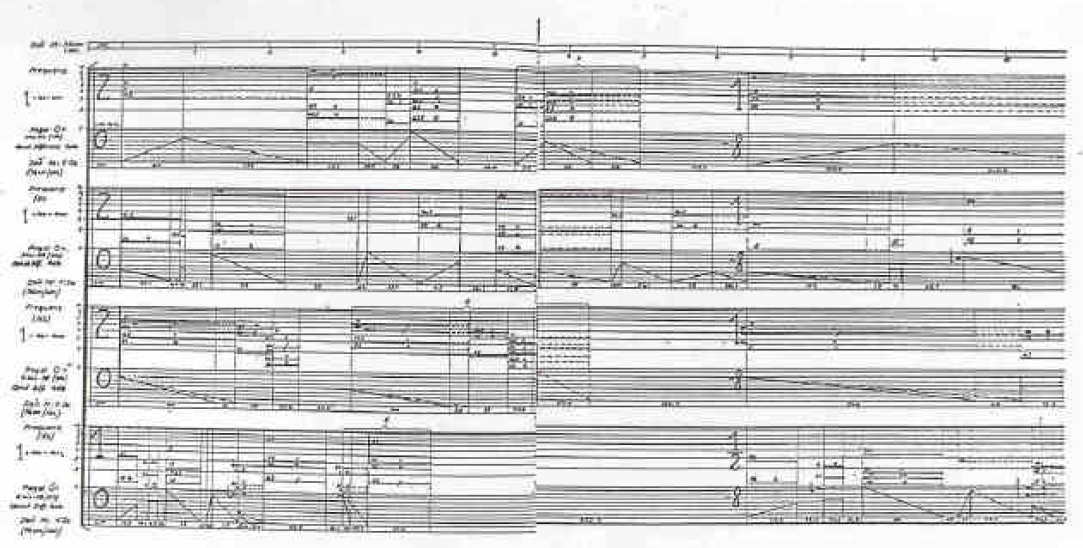
Music, as many of you will remember, used to have lines and rectangles that filled up the page, bar lines perpendicular to staff lines, with lots of circular dots telling the performers what keys to play.
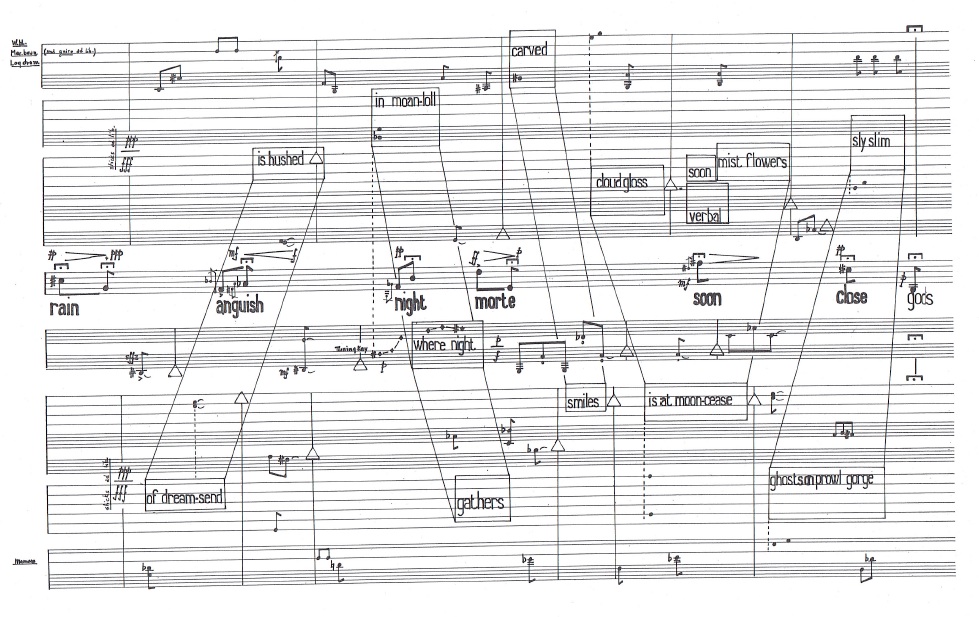
But in the 1950s, the look of printed music began to change (Berio's Circles):
Often the lines weren't so perpendicular anymore (Berio, Points on the Curve to Find):
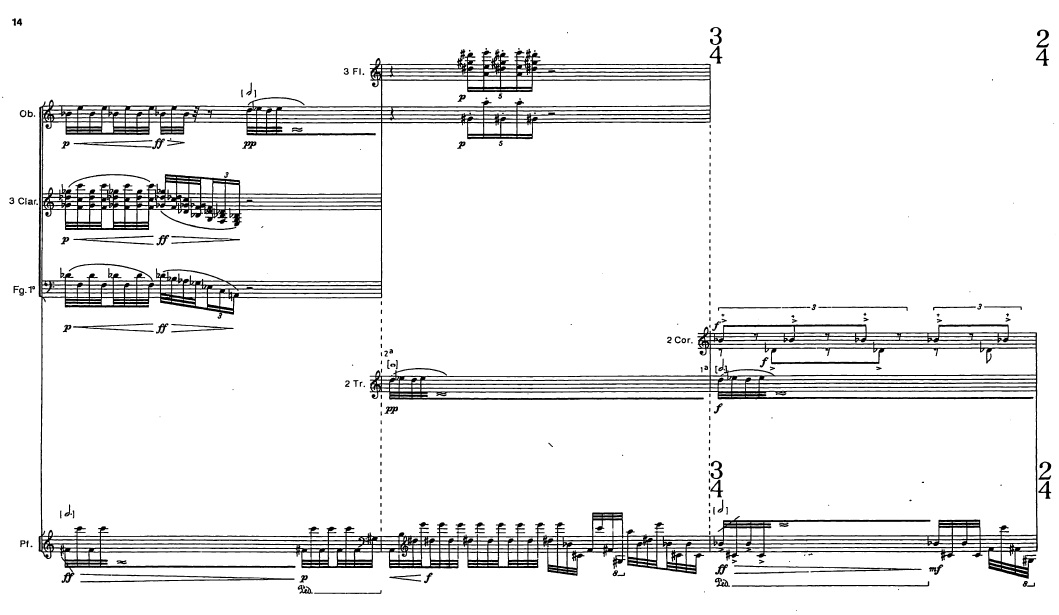
Suddenly there was a lot of white space on the page, as measures disappeared when no one was playing in them (Stockhausen, Gruppen):
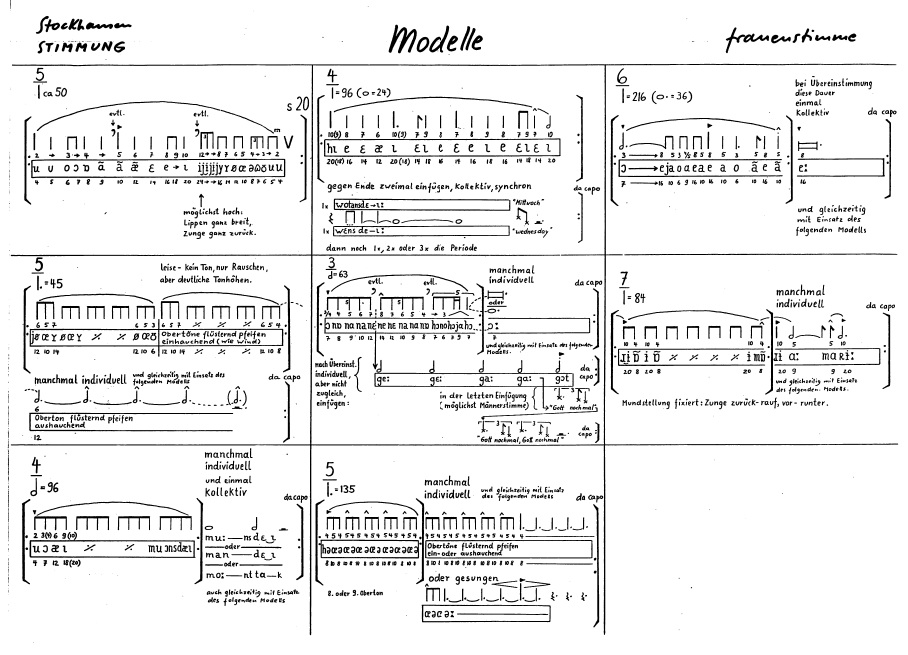
There were new symbols (Stockhausen, Stimmung):
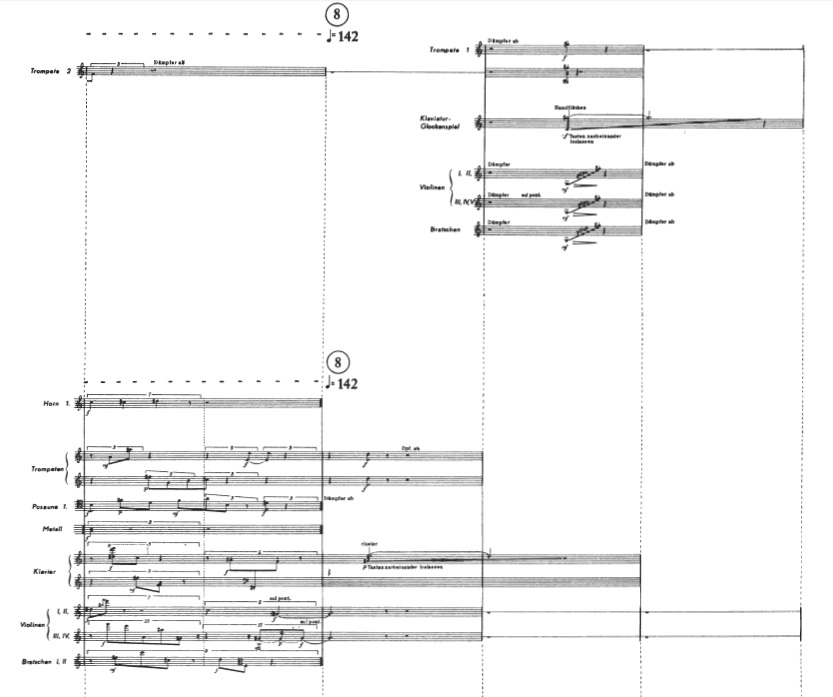
and a lot of directions on the page (Stockhausen, Studie I):
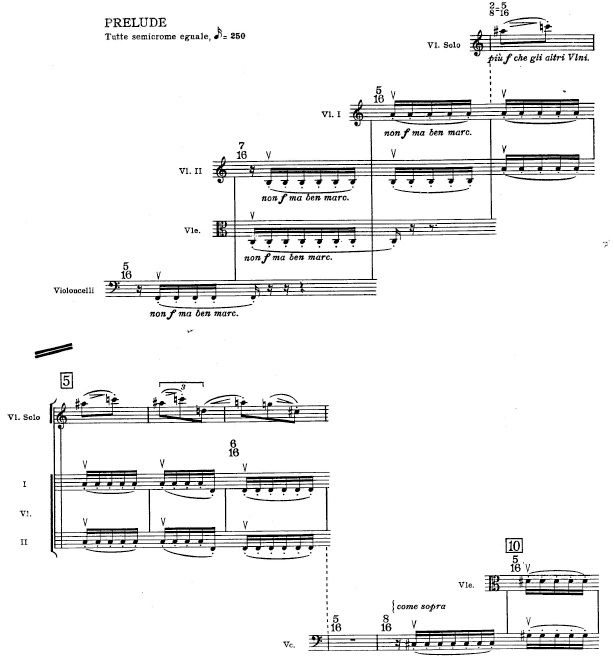
Sometimes pitch was indicated by lines rather than dots. Though most of these scores were by composers in their twenties and thirties at the time, even the elder statesman Igor Stravinsky felt pressured to get into the act (Stravinsky, Requiem Canticles):
The pioneers of these new-fangled-looking scores were mostly European. A few Americans (Brown, Available Forms II):
entered the competition, some aggressively trying to outdo the Europeans in weirdness (Cage, Aria):
But the Europeans were better funded, had more resources, and they were just aesthetically way ahead. We Americans were in awe of them. It looked like they had changed the way music was going to look now - possibly forever.
And then, one day, George Crumb rode into town. (Crumb, Makrokosmos I:
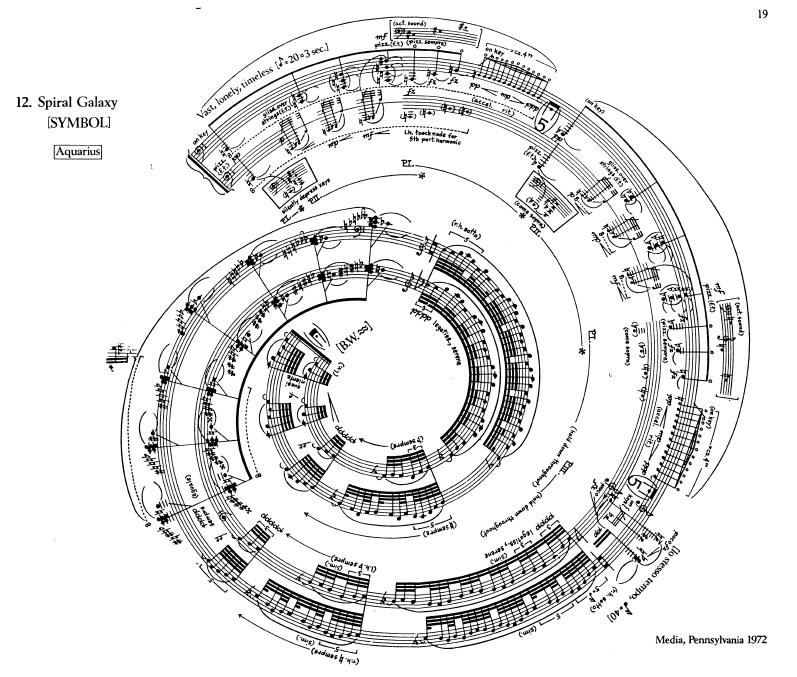
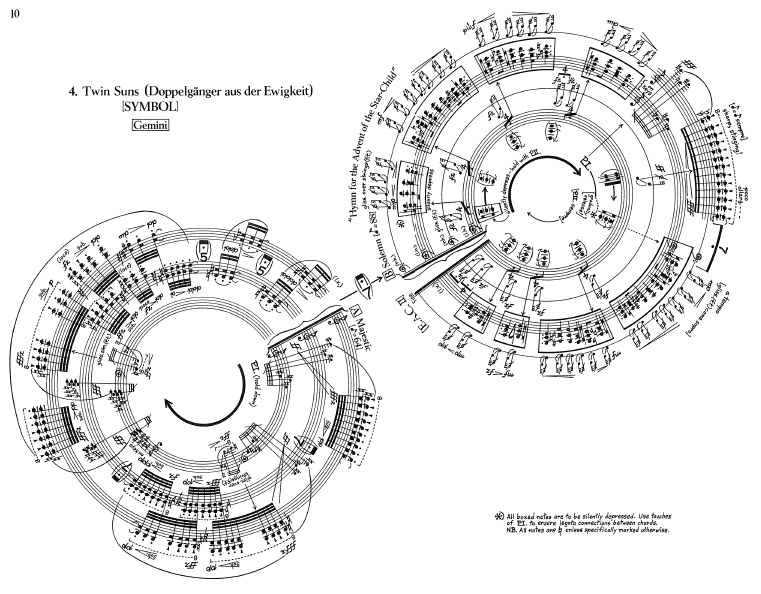
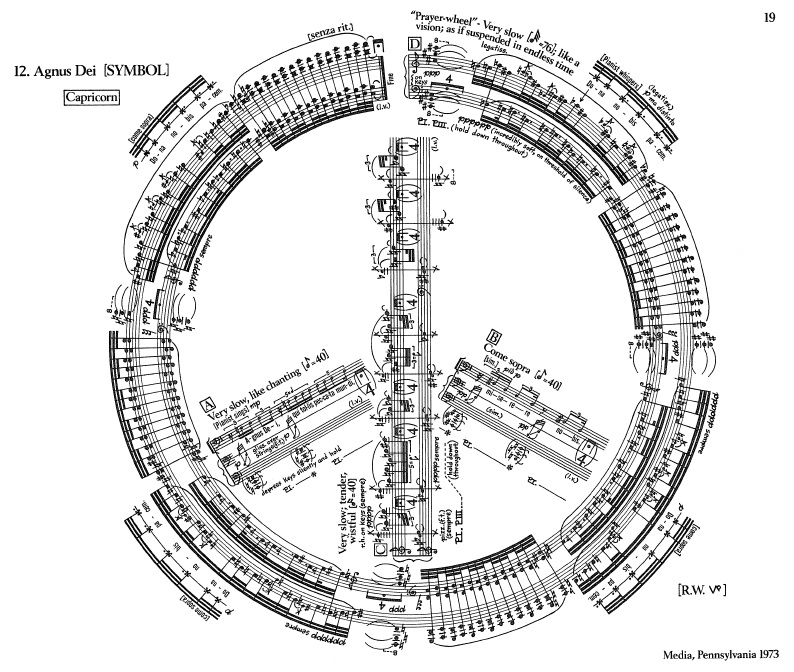
A pen-slinging American walked in with his Rapidograph and blew the Europeans away. Crumb grew up with a father who engraved music, and he had imbibed notational skills far beyond all those fancy Europeans. He was so good that his published scores were copies of his manuscripts, and they looked like they were engraved. His curves were exact, his sharp new symbols looked machine-cut. He drew his music in circles (Crumb, Makrokosmos II):
He drew it in spirals. He made people read music upside down and sideways. He used the shape of the score to spell out the symbolism of his music (Crumb, Makrokosmos II):
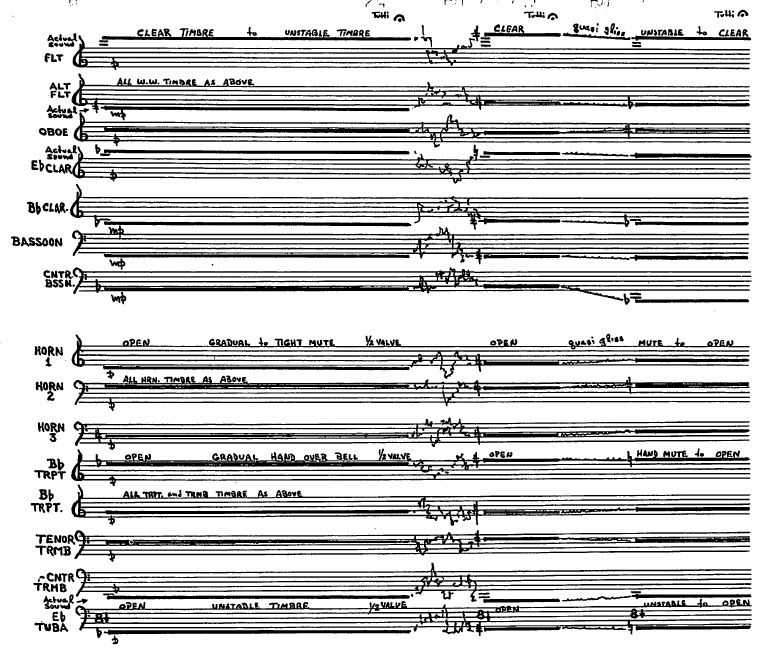
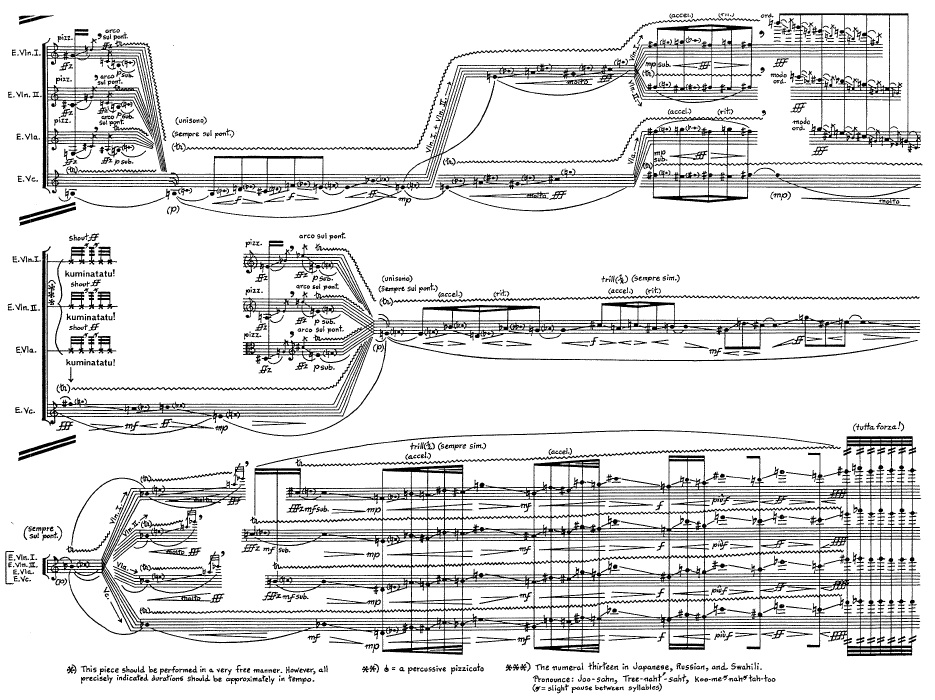
He split off musical lines and recombined them when the instruments started playing together again (Crumb, Black Angels):
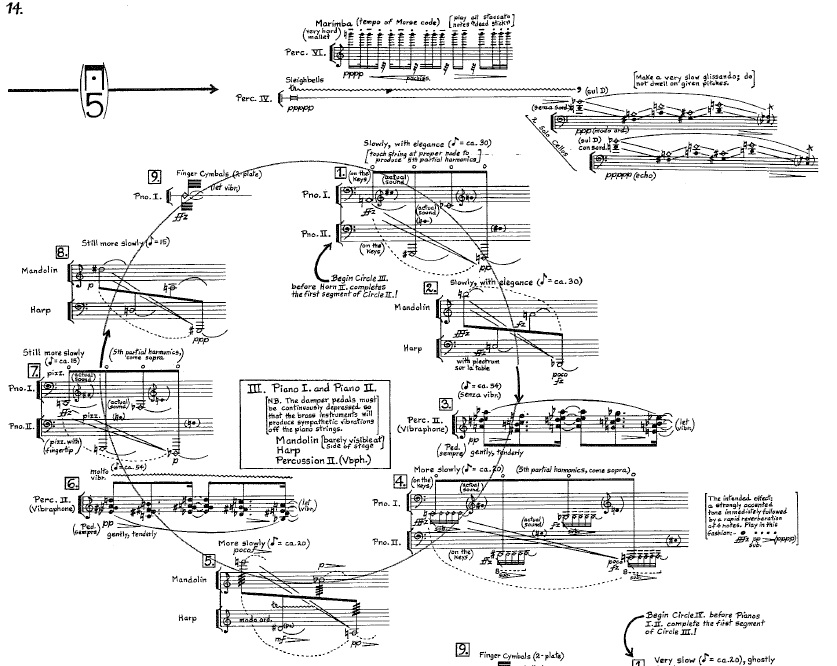
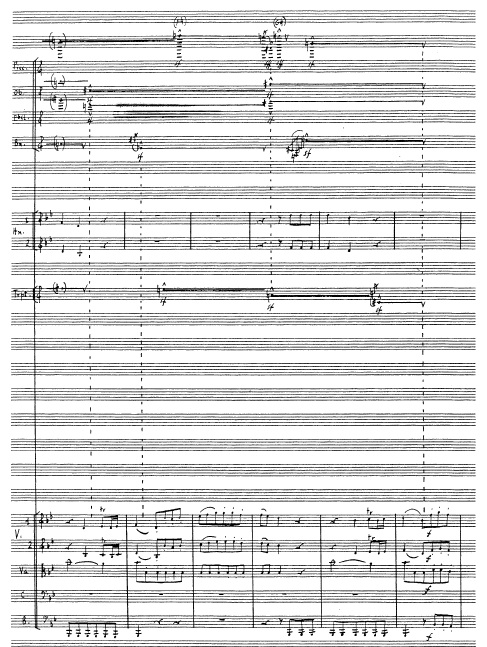
It was like playing a map of the Chicago trainyards. He pasted different parts around the page to set performers free from the meter (Crumb, Echoes of Time and the River):
He could do anything. Suddenly those Europeans didn't look so intimidating anymore. George Crumb walked onto the world stage of musical notation holding a royal flush, and the best anyone else could produce was three of a kind.
I'm making it sound like a joke, but this is actually exactly how it felt in the 1970s. It was exhilarating, but, for us composers, after awhile also kind of deflating. Crumb raised the ante so far that nobody else could imagine learning to do that. Little by little composers quit competing in the weird notation sweepstakes. Pages from Crumb's scores quickly started appearing in textbooks and histories, as startling visual emblems for how far out the new music had gone. He was famous overnight, a new fixture in the canon. An American had won the contest, but none of the rest of us were going to beat him either. And I have always been tempted to think that, over the next few years, music eventually went back to looking kind of normal partly because no one else could compete with the visual virtuosity Crumb wielded so effortlessly.
Of course, notation has to do only with how the music looks, not how it sounds. The sound of Crumb's music, even its theatrical practice onstage, was as as original as the notation. He had members of the orchestra chant Latin mottos in rhythm. He had a string quartet bow wine glasses. He made everyone suddenly want a set of antique cymbals. A mandolin joined the orchestra. Possibly as an inheritance of his West Virginia upbringing, he used a musical saw, fer god's sake. Plucking the piano, which was a novelty when Henry Cowell introduced it in the 1920s, became commonplace, augmented by beating it with mallets. Crumb's eerie new soundworld resonated with the lingering decay of strange, massive sonorities. He wrote tonal music in an atonal age, but made it sound so other-worldly that the atonal parts of his music sounded normative, while the tonal quotations sounded like transmissions from Mars.
Crumb's impact at the time was enormous. At age 17 I hung on his every note. He invented a new world of music, but it was so personal to him that his imitators, of whom I was definitely one for awhile, quickly realized that they couldn't share it without looking like epigones. Today, looking back in retrospect, what looks interesting is how Crumb combined and crystallized so many diverse trends that other composers were also working on, all in an attempt to make their graceful exit out of twelve-tone music, what was called and considered "the international style." Crumb's music was so distinctive that to this day it has obscured parallels that existed between his music and that of other composers who were never associated with him. Those parallels are what I'd like to talk about today. I would like to now bring some of those parallels out.
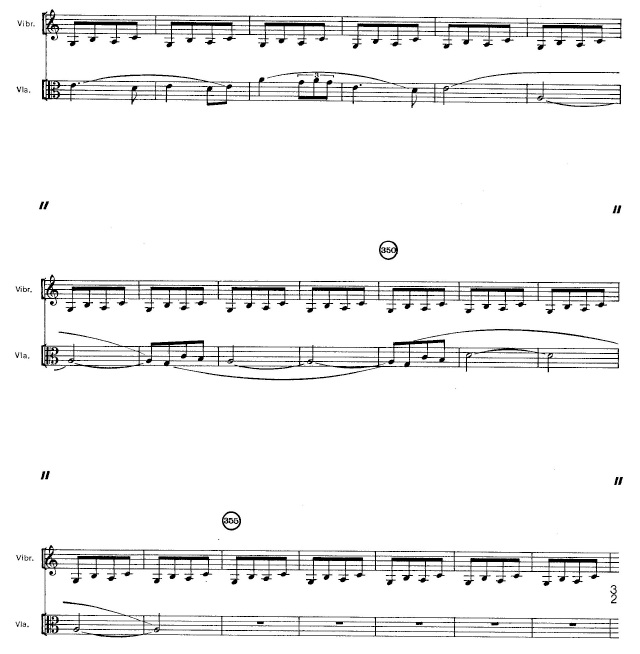
First of all, Crumb had started off as a twelve-tone composer himself. The imprint of the tonality-defeating dissonance of twelve-tone intervals has continued to run through his music his entire career. But as early as Echoes of Time and the River (1967) he started to isolate what seemed like little bits of a twelve-tone row and repeat them meditatively, creating dissonant moments of stasis.
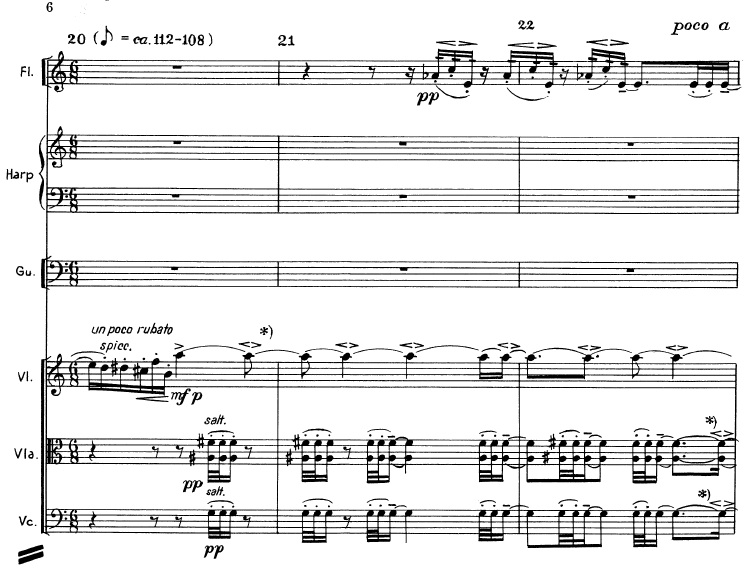
I want to compare Crumb's music in this respect with that of some other American composers of his generation. First, let's look at George Rochberg's Serenata d'Estate, which was a full-fledged twelve-tone piece from 1955. Later, Rochberg and Crumb would both teach at the University of Pennsylvania (Rochberg from 1960, Crumb from 1965), and it is interesting to note similar preoccupations in their music of the 1960s despite their very different styles and concerns. In the Rochberg passage we see here, we hear the last six notes of a row in the violin, and then a chord made up of the first three notes of another row is sustained for several measures as the flutist plays the 4th, 5th, and 6th notes over and over meditatively, creating a bittersweet atmosphere and a protominimalist continuity.
I think that I probably don't need to delineate at this date why certain composers felt a need to escape the arbitrary and often stifling conventions of the twelve-tone idiom. The necessity of having to go through all twelve pitches every measure or so put harmonic variety out of reach except on the most microscopic level. Ultimately, European composers seemed able to walk away from the style nonchalantly and without penalty, but Americans were frequently cowed by peer pressure to keep trying. And so several American composers subverted the idiom by isolating quasi-twelve-tone melodic fragments and repeating them to write passages of harmonic stability. It's remarkable how much like Crumb's music this Rochberg passage sounds, but I wouldn't imply that Crumb picked up the idea from Rochberg. Musicologists love to look for lines of influence, but we composers are more aware that if you put several us in a certain situation and pressure us in a certain dicrection, we just might all come up with the same idea independently.
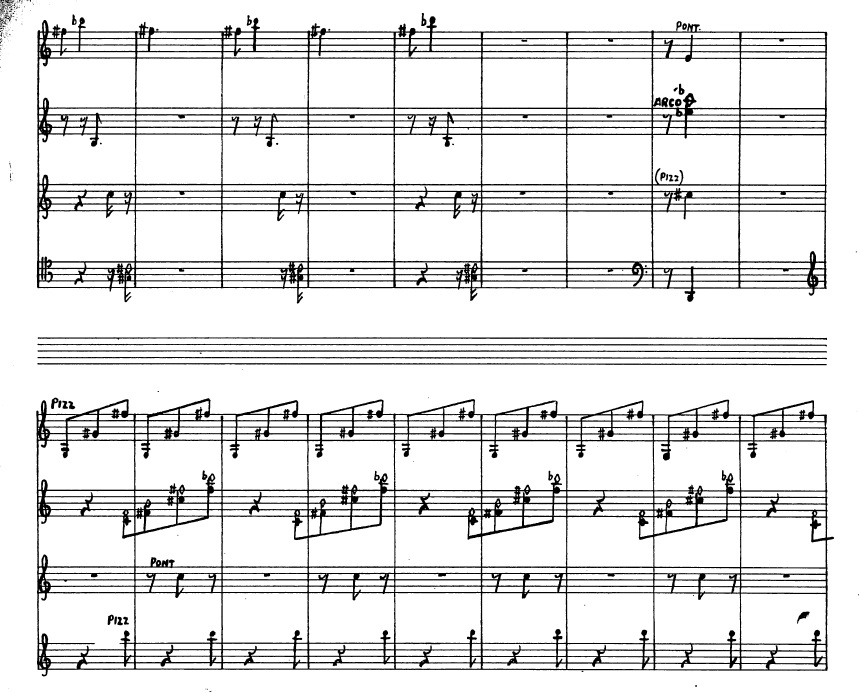
Take another composer who never, as far as I know, wrote an actual twelve-tone piece, but whose music started off predicated on the textural style of Anton Webern. I'm talking about Morton Feldman. Feldman never lost interest in the kind of short motives he picked up from Webern, and I think he became as influential as he did in the late 20th century largely because although he abandoned everything else about modernism, he retained its pitch language. This [*Feldman Structures] is a page from Feldman's Structures for string quartet from 1951. The intervals have a serialist angularity and dissonance, but by repeating them in a 3/8 pattern Feldman makes almost a minimalist dance from them. [*] Feldman did not continue with this type of repetition at the time, but he returned to it in the 1970s under the influence of - and/or, in competition with - the minimalists.
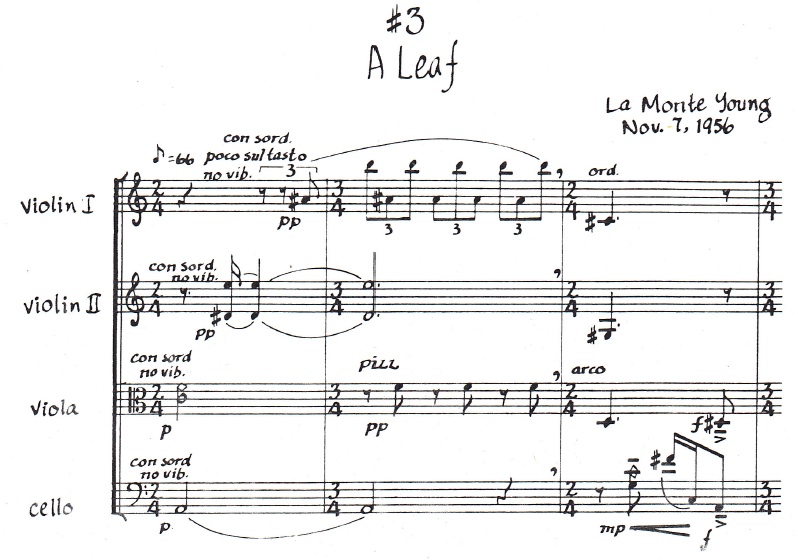
And speaking of whom, let us remind ourselves that minimalism itself was originally an offshoot of serialism. Here [*Young Naiad] is a page from La Monte Young's 1956 string quartet Five Small Pieces: On Remembering a Naiad.
This is a twelve-tone piece, but you can see that Young is enlarging on Webern's aesthetic by repeating pitch complexes to create moments of stasis, moments that he later stretched out to such length that the minimalist movement was the eventual result.
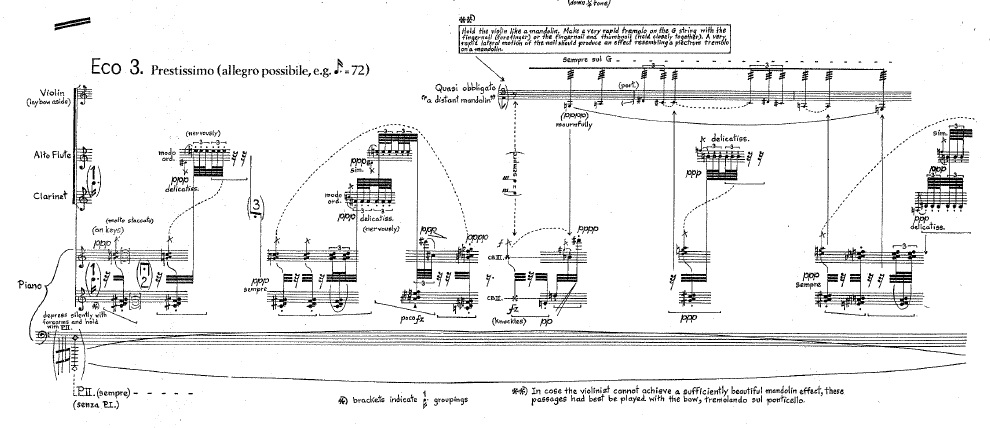
And now let's hear the third movement of Crumb's Eleven Echoes of Autumn from 1965, which likewise uses a group of serialist gestures repeated over and over in in a kind of harmonic stasis. These clusters in the piano never move from their original register, and the violin continues musing on the same few notes. [*] This is from a noncommercial recording made in 1974 in which I am playing the piano along with a couple of my fellow students at Oberlin Conservatory.
Crumb, Rochberg, Feldman, Young: four American composers working within the atomized language of twelve-tone Webern, all finding alternatives to it through stasis and repetition of pitch cells, and then all going on to such different personal styles later in life.
Another major trend of the 1960s and '70s was a tentative return to tonality, first attempted through quotation of historical musics. In this respect it will be telling to compare Rochberg quoting Mozart with Crumb quoting Schubert. This next example is a passage from Rochberg's Music from the Magic Theater of 1965:
The first movement bears a slogan: "Act I: in which the present and the past are all mixed-up... and it is difficult to decide or to know where reality is...." This is the piece in which Rochberg began using quotations as a tentative way of reintegrating tonality, including this passsage lifted from Mozart's Divertimento No. 15 in B-flat, K. 287 in the first movement. I suppose the question we're supposed to ask here, is the Mozart real and the dissonant interjections somehow imaginary, or is the atonal texture real and the Mozart only a dream?
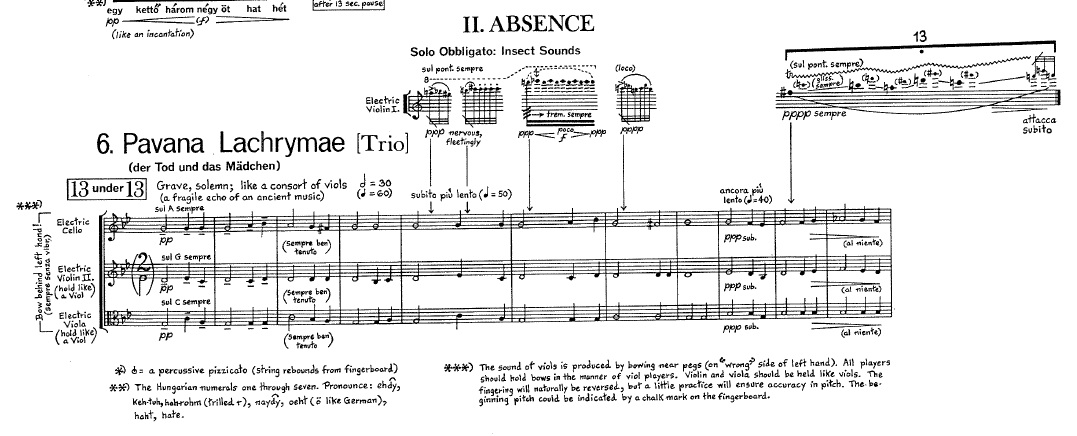
Now let's listen to the section of Schubert's "Death and the Maiden" quartet that Crumb used in his electric string quartet Black Angels of 1970:
Crumb's direction is that "The sound of viols is produced by bowing near pegs (on 'wrong' side of left hand). All players should hold bows in the manner of viol players. Violin and viola should be held like viols. The fingering will naturally be reversed, but a little practice will ensure accuracy in pitch." In addition, Crumb asks optimally that the pitch slowly slides downward, over the length of the passage. Rochberg interrupts his Mozart with serialist-style gestures and makes it part of a language of collage. Crumb makes his Schubert sound modernist by playing it strangely, blurring the pitch, and adding a high violin line that seems to emanate from it, as though this is Schubert coming back to us in a transmission from a distant planet. Rochberg's Mozart is nostalgic. Crumb's Schubert is alienated, though with a weird feeling of recognizability.
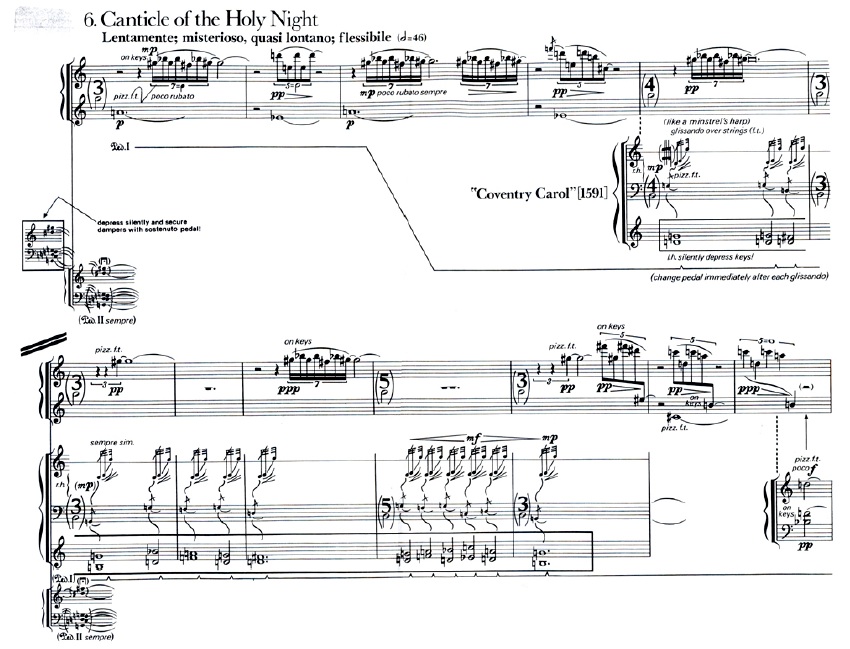
Generally in this period the use of tonality needed to be made ironic by juxtaposing it with dissonant or bitonal material. As another example I want to play movement six from Crumb's Little Suite for Christmas (1980), in which the 16th-century Coventry Carol "Lullay Lullay" is contrasted with atonal or at least dissonant harmonies. Once again Crumb makes the tonal music stranger than the atonal by strumming it inside the piano. [*]
Let's contrast this with a very different-sounding passage from Feldman's Rothko Chapel of 1971. Passages of pure tonality are extremely rare in Feldman's output, but in this famous and remarkable gesture he suddenly introduces a little four-note ostinato in G major accompanying a romantic melody he had written when he was fifteen, and then, with a Crumbian kind of irony but with very different effect, hides the ostinato beneath an atonal cloud of voices returning from earlier in the piece.
Of course, the ironic use of historical quotation was not only an American phenomenon - one could bring up many famous European examples - including Zimmermann's Monologe and Photoptosis, Berio's Sinfonia, Pousseur's Jeu de Miroir de Votre Faust, Schnebel's Schubert Fantasie, and others - to make the same point. The exit from the international style was also international. But in general, Americans eventually returned to the writing of tonal music with a frankness that Europeans seem to find gauche.
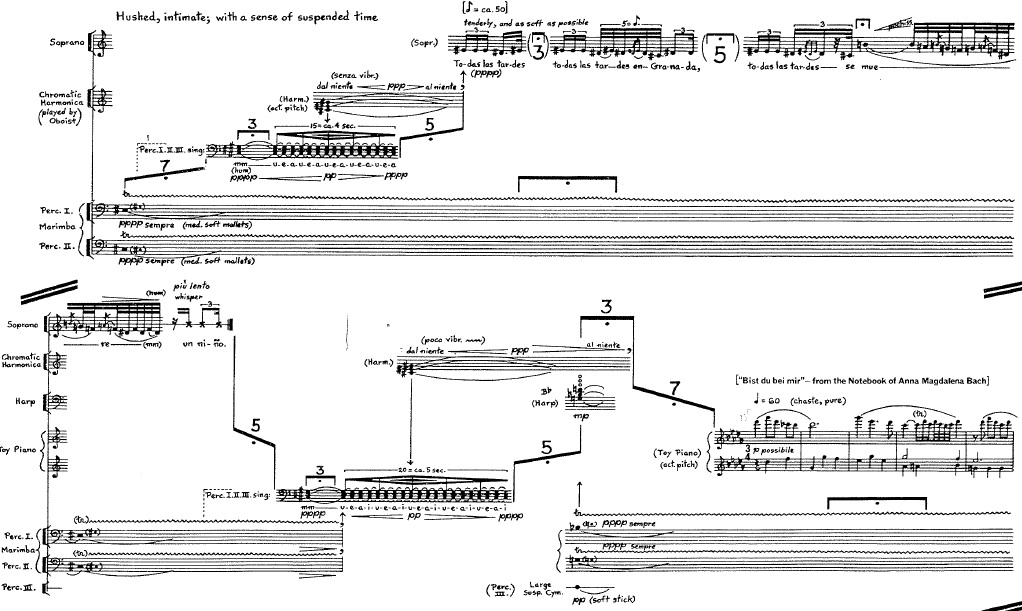
Finally, although Crumb has rarely used passages of undissonated tonality in his music, I want to play one movement of his Ancient Voices of Children from 1970 based entirely on droning major and minor triads. Of course, being Crumb, this is not the hard-edged, sonically conventional minimalism of the minimalists. The opening C#-major triad starts in marimba tremolos, and is then hummed by the percussionists, and then enters softly in a harmonica. The chord then switches to one a tritone away (naturally) by being plucked in harp harmonics. At the end, for some more ironic tonal distancing, we get a Bach keyboard piece played in the tritone-related key of D-flat, made alien once again by being played on a toy piano. [*] To play drone pieces by Americans such as Young would almost be too easy.
Of course, there were also other innovations in Crumb's music that spread through the composition world, such as his odd instrumentations; his practice of having the instrumentalists speak or play small percussion instruments besides their own; and a host of extended instrumental techniques. It would require casting a much wider net to track his influence down through a myriad other composers. Individually, all of Crumb's techniques were widely used by other composers, but the fantastically concentrated fusion of all at them at once was his distinct and instantly recognizable personality.
I make these comparisons with Rochberg, Feldman, and Young not to suggest any lack of originality on Crumb's part. Of course not: his originality was overwhelming, so much so that one could hardly imitate him without being called on it. What I'm interested in is the extent to which he embodied a number of streams through which American composers were trying to find their way out of the abstract atonality of the twelve-tone world into a more atmospheric, evocative, memorable idiom. Many American composers frankly returned to writing tonal music; repetition became a common technique; collages overlaying tonal music with atonal became a way of having one's cake and eating it too, or else commenting on history with some sense of irony, and admitting the artificiality and contingency of musical styles. All of these ideas were increasingly in the air, and Crumb's music fused them all into a single, very personal musical voice: so much so, that unlike with these other composers, it is difficult to play an example of one of these techniques in his music without also including some of the others.
In the 1980s American music was wracked by a struggle between three stylistic groups that we called, in terms of New York City geography, Uptown, Midtown, and Downtown - meaning, respectively, the twelve-tone serialists, the new romantics (including the postmodernists, who quoted widely from the classical literature), and the minimalists. The serialists were based in academia, the new romantics in the well-established classical music institutions, and the downtowners wherever we could find a loft to perform in, and also increasingly popular on recordings. Crumb shared his pitch language, by and large, with the serialists, the great emotive arcs of his music and his quotations with the new romantics, and his tendency toward drone and repetition with the minimalists. I remember being told at the time that he was the most widely performed living American composer. But he remained what Morton Feldman would have called one of the "jokers in the deck," a composer who was unaffiliated, that no collective aesthetic could fully claim. In short, Crumb carved his own path from modernism to postmodernism, one that virtually no one else could follow with him. He had pervasive connections with serialism, the new romanticism, minimalism, and experimentalism, to all different vistas of the American musical landscape; and yet, to this day, looking back forty years, we can only think of Crumb's music as being purely George Crumb.
Copyright Kyle Gann 2017
Return to the Kyle Gann Home Page
If you feel moved to reply to any of this, email me